



Promotional Product Distributor Supplier Guide
Share
A promotional product distributor supplier has to do more than print a logo and ship cartons. When your client needs 500 or more giveaway items, the real job is preventing the expensive mistakes: artwork that looks weak at small size, a scent choice that misses the audience, packaging that was not planned, or a production file approved by the wrong person.
For distributors and resellers, custom hanging car air fresheners can solve a problem that pens, magnets, and keychains often do not. They stay in a vehicle where the recipient sees them repeatedly for weeks. That makes them particularly useful for dealerships, repair shops, detailers, insurance agencies, real estate teams, and any client whose relationship with customers includes a car.
What a promotional product distributor supplier should handle
The right supplier makes you look organized in front of your client. That starts before production. You need a clear minimum quantity, reliable decoration specifications, a proof process that gives the client a real chance to approve the artwork, and shipping terms that do not change at checkout.
At Just Hang Fresheners, orders begin at 500 units. That quantity is practical for a single dealership, a regional trade show, a real estate office with multiple agents, or a distributor placing a focused client order. Larger quantity breaks at 1,000, 2,500, and 5,000 units generally improve unit economics because setup and production costs are spread across more pieces.
That does not mean 5,000 units is always the smart recommendation. If your client is testing a campaign, opening one location, or planning a single event, 500 or 1,000 may reduce inventory risk. For a multi-location oil change chain or dealer group that gives an item to every customer, larger runs are usually easier to justify because the product has a defined distribution path.
A supplier should also be honest about what the product is. A hanging paper air freshener is not a high-end corporate gift. It is a low-cost, repeat-visibility promotional piece. Its value comes from being used in a personal space, not from being handed over in a presentation box.
Why custom car air fresheners work for repeat impressions
A flyer gets one look. A business card may go into a wallet or a desk drawer. A car air freshener remains in the vehicle, often near the rearview mirror, with the brand name and message in view during routine driving.
The format works best when the message is simple. A dealership may use its logo, phone number, and service department reminder. A real estate team might use a recognizable house-shaped design, agent branding, and a short closing message. A detailing business can lead with a clean visual identity and a QR code only if the code remains large enough to scan.
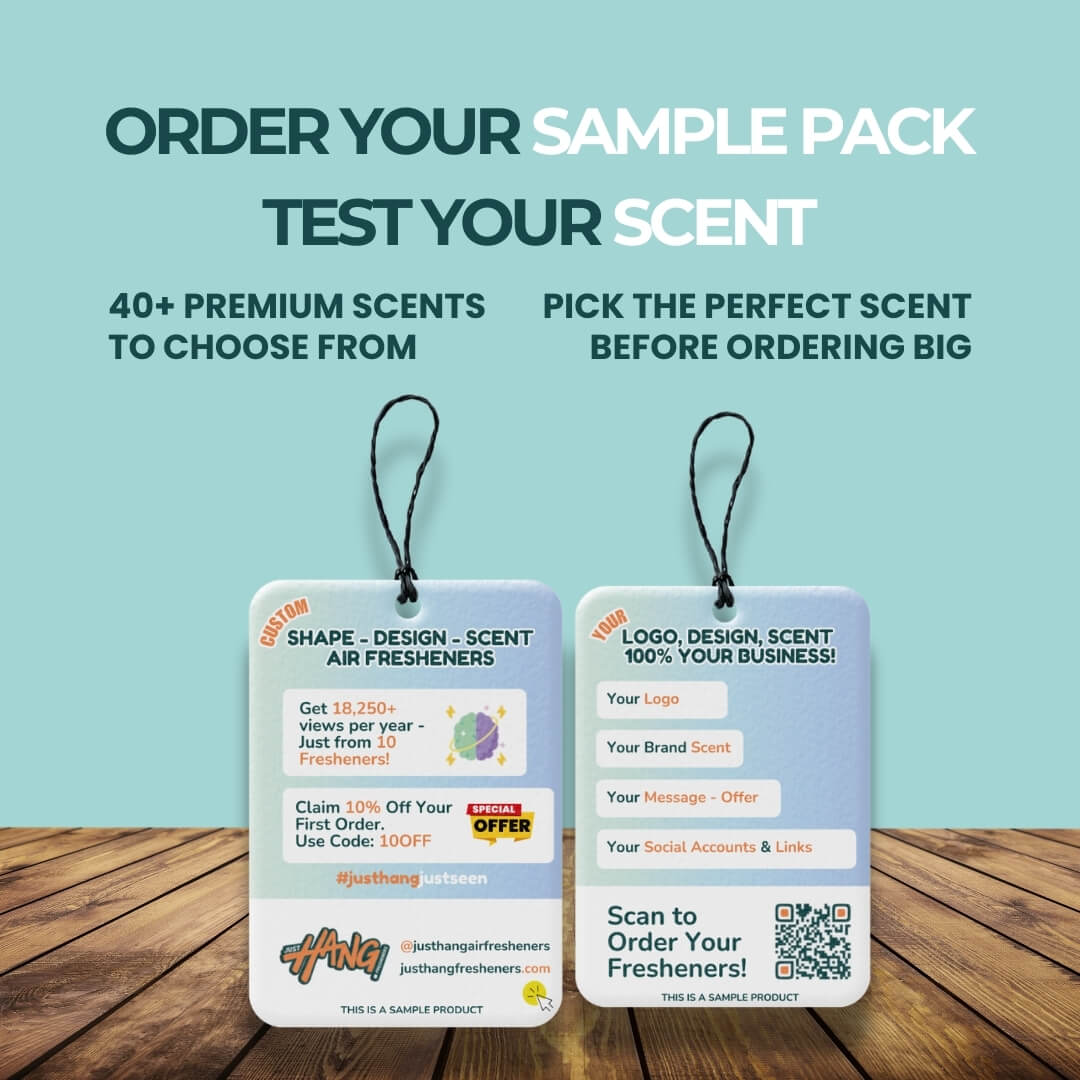
Double-sided, full-color printing matters here. The freshener can rotate, and passengers may see the opposite side. Instead of repeating the same artwork, many clients use one side for the logo and core message, then use the other for a service reminder, location list, event date, or call to action. The artwork should still feel like one campaign, not two unrelated ads.
Scent adds a second layer of recall, but it should not carry the whole campaign. We offer more than 40 fragrance options, covering fresh, fruity, clean, and seasonal directions. For a broad audience, a familiar fresh or clean option is often the safer choice. A more distinctive fragrance can work for a brand with a strong personality, but it is worth confirming that the client is comfortable with a narrower preference profile.
Specifications to confirm before you quote the client
Before presenting an estimate, get the practical details in writing. A short discovery conversation saves more time than revising an assumed design after proofing.
| Item | What to confirm |
| --- | --- |
| Quantity | Start at 500 units; ask whether the client needs 1,000, 2,500, or 5,000 for multiple locations or events. |
| Shape and size | Choose a custom shape that supports the logo without making text too small. |
| Artwork | Confirm logo files, required copy, brand colors, and whether a QR code or phone number must appear. |
| Printing | Use both sides deliberately, with full-color artwork designed for viewing at a small scale. |
| Fragrance | Select from available fragrance options based on the audience and campaign use. |
| Packaging | Decide whether individual branded packaging supports the client’s presentation or distribution plan. |
| Delivery | Confirm the in-hands date early, especially for trade shows, grand openings, and seasonal campaigns. |
Custom sizing is useful, but it comes with a trade-off. A small freshener can be economical and easy to distribute, yet detailed logos and long web addresses become difficult to read. A larger shape gives artwork more room but may not be necessary for a simple logo. We usually recommend starting with the visual hierarchy: what must be read from a normal distance, and what can be left off.
Artwork approval is where distributor orders are won or lost
Promotional distributors are often managing approvals through a client contact, marketing manager, and sometimes a corporate brand team. The mistake is treating the proof as a formality. Once production begins, fixing a missed phone number, low-resolution logo, or outdated event date is not simple.
Send the supplier the best available source files. Vector formats such as AI, EPS, PDF, or SVG are typically best for logos because they stay sharp when sized for print. High-resolution PNG or JPG files can work when they are large enough and clean, but a screenshot pulled from a website is rarely a good starting point.
Free professional design service is especially helpful when the client only has a logo and a rough idea. It does not remove the need for clear client direction. Give the designer the exact wording, preferred colors, required legal copy if applicable, and any placement requirements. Then make sure the final decision-maker reviews the proof.
We provide unlimited design revisions and require customer approval before manufacturing. That approval step protects the distributor as much as it protects the buyer. It establishes that the approved spelling, color treatment, layout, shape, and fragrance selection are the version that will be produced.
How to position the item to different client types
The best pitch is tied to how the client already acquires or retains customers. Do not sell a freshener as generic swag when it can serve a specific business purpose.
For dealerships, it can be part of the delivery experience or a service-lane reminder. The air freshener gives the dealership a physical presence after the vehicle leaves the lot, and the second side can point drivers toward maintenance or future trade-in conversations.
For repair shops, tire stores, car washes, and detailers, the product fits naturally at checkout. It reinforces the feeling that the vehicle has been cared for and gives the customer a reason to remember the shop next time service is needed.
For real estate professionals, it works as an affordable addition to a closing gift or an open-house handout. The key is restraint. Use the agent or brokerage identity, a clear contact method, and a design the recipient would be comfortable hanging in their car.
For trade shows, it is more memorable than another handout if the fragrance and visual design support the booth theme. Plan quantities against expected traffic, but do not assume every visitor should receive one. A targeted giveaway for qualified conversations may create less waste and gives staff a natural reason to start a conversation.
Questions distributors should ask before placing the order
Ask whether the client has a firm event date, whether packaging is required, and who owns final proof approval. Also confirm where the cartons are going. Free nationwide shipping to all 50 states simplifies the order, but one central delivery address is different from a multi-location distribution plan.
Ask how the client will hand out the product. If staff will give fresheners to customers one at a time, branded packaging can make the item feel more finished and preserve the scent until use. If the order is being inserted into a large event bag, simpler packaging may be the better fit. The right answer depends on presentation, budget, and distribution method.
Finally, set expectations around timing without promising what has not been confirmed. Custom artwork, revisions, client approval, manufacturing, and shipping all need to happen in sequence. Start the design process before the event deadline becomes urgent, especially when several stakeholders need to sign off.
FAQ
What is the minimum order for custom car air fresheners?
The minimum order is 500 units. Quantity options at 1,000, 2,500, and 5,000 units can be a better fit when the client has multiple locations, a large event, or an ongoing customer giveaway program.
Can a distributor submit client artwork for design help?
Yes. We provide professional design service with unlimited revisions. Send the clearest logo files and the exact copy the client wants included, then review the proof carefully before approval.
How long does the fragrance last?
The scent is intended to provide fragrance for weeks in a vehicle. Results vary based on fragrance choice, whether the freshener stays sealed until use, vehicle conditions, and how the recipient uses it.
Can both sides have different artwork?
Yes. Custom fresheners are printed in full color on both sides. Many clients use one side for brand identity and the other for a service message, contact details, or campaign-specific information.
Is shipping available across the United States?
Yes. Orders ship free to all 50 states, with production, design support, and customer service based in the Atlanta, Georgia area.
If you are sourcing for a client, bring us the quantity, target in-hands date, logo files, and basic campaign goal. Request a custom mockup before you promise a design direction, and you will have a clearer approval path from the first proof onward.


