



Paper Air Fresheners Versus Flyers: Which Works?
Share
A stack of flyers can disappear before an event ends. If you are spending a limited local marketing budget on dealership handoffs, service visits, closings, or trade show bags, paper air fresheners versus flyers is a useful comparison because the two items work on completely different timelines.
A flyer delivers a message once, usually while someone is standing near a counter, booth, or mailbox. A custom hanging air freshener can remain in a vehicle for weeks, keeping your logo, phone number, offer, or service reminder in front of the customer during regular drives. That does not make flyers obsolete. It means you should choose the item based on what you need the campaign to do after the handoff.
Paper Air Fresheners Versus Flyers: The Core Difference
Flyers are built for immediate information. They give you room for a menu, event agenda, promotion details, maps, QR codes, and fine print. If a customer needs to know the date of an open house or the terms of a seasonal service special, a flyer handles that job well.
Paper air fresheners are built for repeat presence. They have less room for copy, so the message needs to be focused: your logo, a short service reminder, a phone number, a website, or one clear offer. In return, the piece is used inside a car rather than read once and placed in a bag, cup holder, or trash can.
For a dealership, repair shop, detailer, car wash, tire store, or insurance agency, that difference matters. The vehicle is already where much of your customer relationship happens. A branded freshener keeps your business visible in that setting without asking the customer to save a separate piece of paper.
What Repeat Exposure Can Look Like
The value of a promotional item is not just its cost to produce. It is the number of meaningful chances it has to be seen. A flyer may be read carefully once, which can be exactly right for a detailed offer. A freshener may be noticed repeatedly during commutes, errands, school drop-offs, and weekend trips.
Here is a simple planning example, not a promised campaign result. If you distribute 500 air fresheners and each recipient sees it twice per day for 30 days, that is 30,000 potential brand views. If only half of recipients hang the freshener and the item stays visible for several weeks, the number still adds up differently than 500 one-time handouts.
The same logic applies to scent. A customer may not consciously read your logo every time they enter the vehicle, but the branded item remains part of the space. With more than 40 fragrance options available, you can choose a scent direction that fits your audience instead of treating the giveaway as an afterthought.
This is why a freshener often works best for retention campaigns, while a flyer often works best for explanation. A repair shop can use a flyer at the counter to describe a maintenance offer, then include a freshener as the item that keeps the shop top of mind afterward.
When Flyers Are the Better Buy
There are situations where the flyer is the practical choice. If your message needs several steps, dates, pricing details, or regulatory language, do not force all of it onto a small hanging product. A real estate brokerage promoting a specific open house, for example, needs property details that a freshener should not try to carry.
Flyers are also easier to revise when an offer changes frequently. If you run a new special every month, printed paper may be the more flexible format for the offer itself. Use it to communicate the changing detail, then use a branded freshener with evergreen contact information to support long-term recall.
Distribution matters too. A flyer can be left on a table in large quantities with minimal interaction. Air fresheners are more effective when handed to qualified customers, included with a completed service, placed in a closing gift, or added to an event bag where the recipient has a reason to keep it.
When Custom Air Fresheners Earn Their Place
A hanging paper air freshener is a better fit when your goal is to stay remembered after a transaction. That makes it especially useful for businesses where the customer may not need you again for several months but should know exactly who to call when they do.
Auto businesses are the clearest example. A customer leaving an oil change, detailing appointment, vehicle purchase, or tire service already has access to a car. Giving them a branded freshener is natural, useful, and relevant to the moment.
The same idea works beyond automotive. A mortgage broker can include one in a closing gift. An insurance agent can use them at community events. A sports team or school fundraiser can offer a custom design supporters will actually display. For trade show organizers, the product gives attendees something more useful than another brochure, provided the artwork is simple enough to read at a glance.
Design Choices That Affect Results
The biggest mistake we see is trying to turn an air freshener into a flyer. Small text, multiple phone numbers, dense service lists, and busy background photography all compete for limited space. A freshener is most effective when it can be recognized in a second or two.
Start with the primary goal. If you want calls, make the phone number prominent. If you want customers to remember a dealership or shop name, put the logo and name first. If you are running a campaign, one short phrase is usually enough. A QR code can be useful, but it should not be the only path to identifying your business.
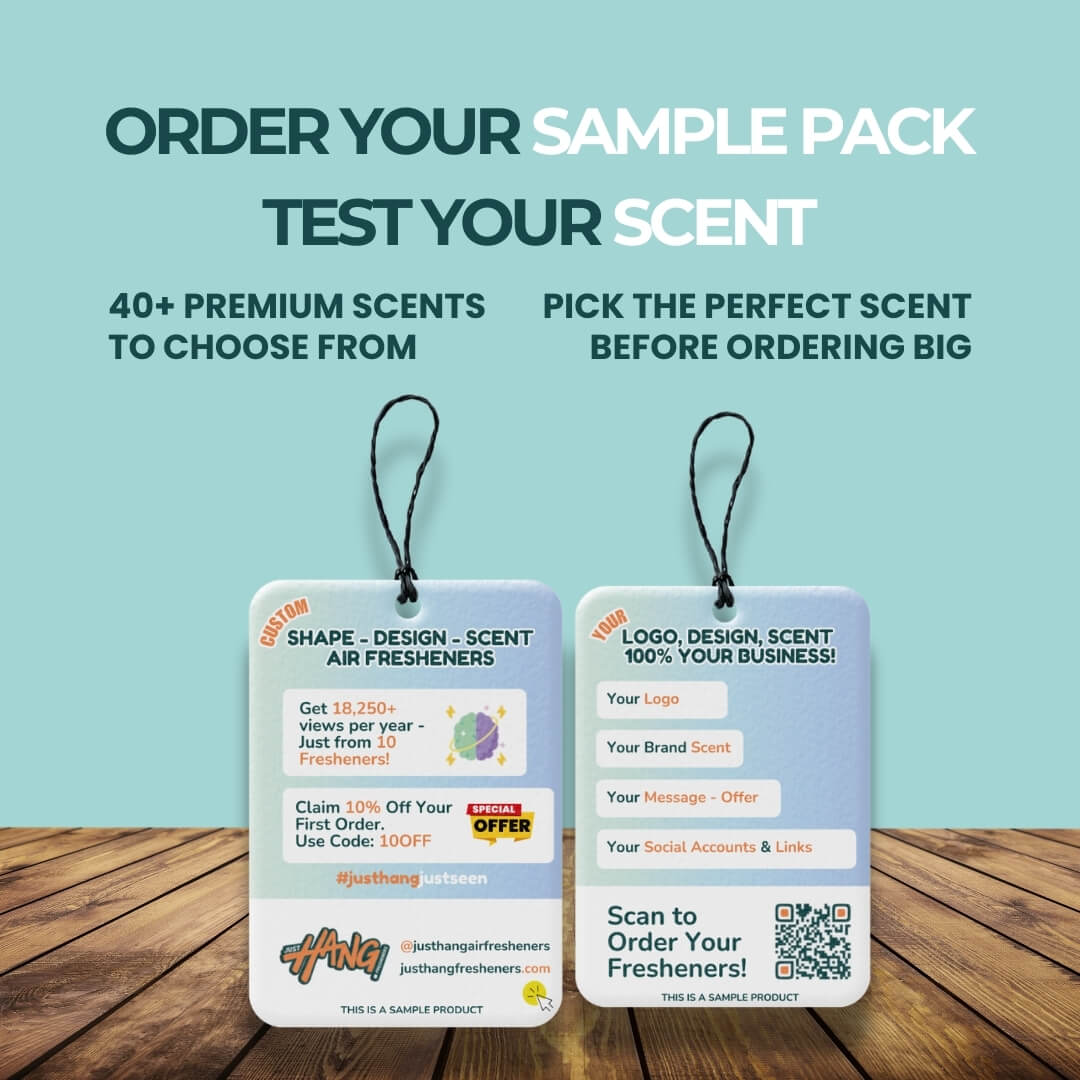
Custom shapes help the item feel intentional, but simple outlines usually print and read better than intricate silhouettes. Double-sided full-color printing lets you put the main brand mark on one side and a service reminder, contact detail, or campaign message on the other. Custom sizing can also help, but larger is not automatically better. The best size is one that fits the artwork cleanly and remains easy to hang.
At Just Hang Fresheners, every order includes professional design service and unlimited revisions before production. You approve the final proof before anything is made. If you have a logo file, send the best version available. Vector artwork such as AI, EPS, or PDF is ideal, while high-resolution PNG and JPG files can also work for many designs. If all you have is an older image from a business card or social profile, we can review it before building the layout.
Quantity, Pricing, and Campaign Planning
Custom air freshener orders start at 500 units. That minimum makes sense for businesses that can distribute consistently through customer visits, multiple locations, service departments, events, or seasonal campaigns. Unit pricing decreases at 1,000, 2,500, and 5,000 units, so the right quantity depends on your actual distribution plan, not just the lowest possible unit cost.
If one location sees 40 to 60 qualifying customers per week, 500 units may be a sensible test quantity. A multi-location dealership group, car wash chain, or promotional distributor may benefit from a higher tier if it has a clear plan to move the inventory. Ordering 5,000 items without a distribution system can create storage problems and dilute the campaign. Ordering too few can raise the cost of a program that you already know will be repeated.
Optional branded packaging is worth considering when presentation matters, such as a vehicle sale, closing gift, trade show kit, or reseller program. For routine service-lane handouts, simpler packaging may be the better use of budget. The product should match the moment, not add decoration nobody needs.
Production begins after your artwork approval, so build proofing time into your schedule. We handle design and support from the Atlanta, Georgia area and ship free to all 50 states. The earlier you start, the more time you have to refine artwork, confirm fragrance choices, and coordinate distribution without last-minute decisions.
A Better Way to Use Both
For many campaigns, this is not an either-or decision. Use a flyer for the information that needs to be read now, then use a custom air freshener for the reminder that needs to last. A service department can attach a maintenance offer to an invoice and hand over a freshener at checkout. A real estate agent can provide detailed property materials at an open house and reserve fresheners for closing gifts or client follow-up.
That pairing gives each item one clear job. The flyer explains. The freshener stays.
Frequently Asked Questions
How long does the scent last?
The scent is designed to last for weeks in normal vehicle use. Fragrance strength and duration can vary based on when the package is opened, vehicle temperature, and ventilation.
What is the minimum order for custom air fresheners?
The minimum order is 500 units. Higher quantity tiers at 1,000, 2,500, and 5,000 units reduce the per-unit cost.
Can you help if we do not have finished artwork?
Yes. Professional design service and unlimited revisions are included. We create a proof and require your approval before production begins.
Can we print different artwork on both sides?
Yes. Custom air fresheners can be printed in full color on both sides, allowing you to pair a logo with contact information, a short reminder, or a campaign message.
If your flyers explain the offer but your brand disappears once the customer leaves, request a custom mockup and build the follow-up item around the vehicle they use every day.


