



How to Improve Service Customer Retention
Share
A customer may be happy when they leave your service drive, detailing bay, repair shop, or closing appointment. The harder question is whether they will remember you when they need help again. To improve service customer retention, you need more than a good transaction - you need a practical reminder that stays with the customer after the receipt is filed away.
For businesses that serve drivers, a custom hanging air freshener solves part of that problem in a place most giveaways never reach: inside the vehicle. It is visible repeatedly, carries your logo and contact information, and can remain in use for weeks. That does not replace good work, fair pricing, or a useful follow-up process. It gives those efforts a better chance of being remembered.
Why good service alone does not guarantee repeat business
Service businesses often lose repeat customers for ordinary reasons. A driver moves their next oil change somewhere closer. A homeowner remembers the real estate agent but cannot find their number. A car wash customer gets a coupon from another location at the right moment. None of these outcomes necessarily mean the original experience was poor.
The gap is recall. If your brand is not visible when the next need appears, convenience and the latest offer usually win.
A business card can sit in a console. A pen may end up in a kitchen drawer. A hanging air freshener is different because the customer decides whether to use it, then sees it on regular trips. That makes it useful for dealerships, tire shops, collision centers, detailers, insurance agencies, and local professionals whose customers spend time in their vehicles.
The goal is not to turn one promotional item into a retention strategy by itself. The goal is to create a low-cost physical touchpoint that supports the service experience you already worked to deliver.
Improve service customer retention with a post-service reminder
The best time to give a branded air freshener is when it feels connected to a completed service, not when it feels like a random giveaway. For an auto repair shop, that can be at vehicle pickup. For a dealership, it may be placed in the car after delivery or included with a maintenance visit. For a real estate agent, it can be part of a closing gift or a welcome packet for a buyer who will be driving between their old home and new one.
The message should match that moment. A detailer might use a simple logo, phone number, and “See you next time.” A dealer may add a service department reminder. An insurance agent may emphasize local availability rather than trying to fit every policy type onto a small printed area.
Trying to place five services, three phone numbers, a QR code, a slogan, and a full street address on one freshener usually creates clutter. The customer should be able to recognize your business in a second. If they need to contact you, one clear phone number or website address is often more useful than a crowded design.
Make the next visit easy to remember
Retention works best when the air freshener and your follow-up system point in the same direction. If you send maintenance reminders by text or email, use the same logo, colors, and basic message on the freshener. If your front desk asks for reviews, do that after the customer has had time to evaluate the work, not while they are standing at the counter.
For recurring services, connect the giveaway to a natural return cycle. An oil change business can hand one out after a visit while explaining the next recommended interval. A car wash membership program can use it as a small appreciation item for sign-ups or renewals. A dealership can reserve a higher-volume order for vehicle deliveries and service-lane retention efforts.
The item is most effective when it reinforces a useful conversation rather than substituting for one.
Choose quantities based on your service volume
Custom printed air fresheners are typically most efficient when ordered for an actual distribution plan. At Just Hang Fresheners, the minimum order is 500 units, and unit pricing improves at 1,000, 2,500, and 5,000 units. That does not mean every business should automatically order 5,000.
A single-location shop that completes a few hundred qualifying customer visits each month may find 500 or 1,000 units easier to distribute consistently. A multi-location dealer group, franchise, conference organizer, or promotional distributor may benefit from higher volume because the order can be allocated across locations or events.
| Order quantity | Best fit | Planning question |
| --- | --- | --- |
| 500 | Testing a post-service giveaway or supporting one location | Can your team distribute every unit with a clear purpose? |
| 1,000 | Established service reminders, delivery gifts, or seasonal campaigns | Will the design stay relevant long enough to use the full quantity? |
| 2,500 | Multiple departments, locations, or recurring events | Can you keep messaging consistent across the campaign? |
| 5,000 | Larger networks, distributors, and broad customer retention programs | Do you have storage and a location-by-location allocation plan? |
Before choosing quantity, divide the order by the number of customers who will actually receive one each week. That gives you a practical distribution window. A lower unit cost only helps if the product is handed out while the design, phone number, and offer are still current.
Measure impressions without pretending every impression is a sale
Promotional products are often judged too quickly: “Did this one item produce a trackable booking?” That is a fair question, but it is not the only one. A retention item also works as a repeated brand cue between visits.
Start with a simple planning formula:
Estimated cost per retained customer = campaign cost / customers who return during the period you are measuring.
Then compare that result against other retention spending, such as postcards, paid search, loyalty discounts, or referral incentives. You do not need to claim that every freshener created a return visit. You need to know whether the program supports profitable repeat business at a cost that makes sense for your average customer value.
You can make attribution clearer by using a unique service code, a dedicated landing-page address, or a specific call-to-action on one side of the design. There is a trade-off. A discount can make tracking easier, but it can also train customers to wait for an offer. For many service businesses, a message like “Keep us in your car for the next time you need us” protects the brand better than a permanent discount.
Get the design right before production
A custom air freshener has limited space, so artwork decisions matter. Use a high-resolution logo whenever possible. Vector files such as AI, EPS, or PDF are ideal for clean print edges, while high-resolution PNG or JPG files can work for simpler artwork. Avoid sending a screenshot, a social media profile image, or a logo pulled from a website if a better source file is available.
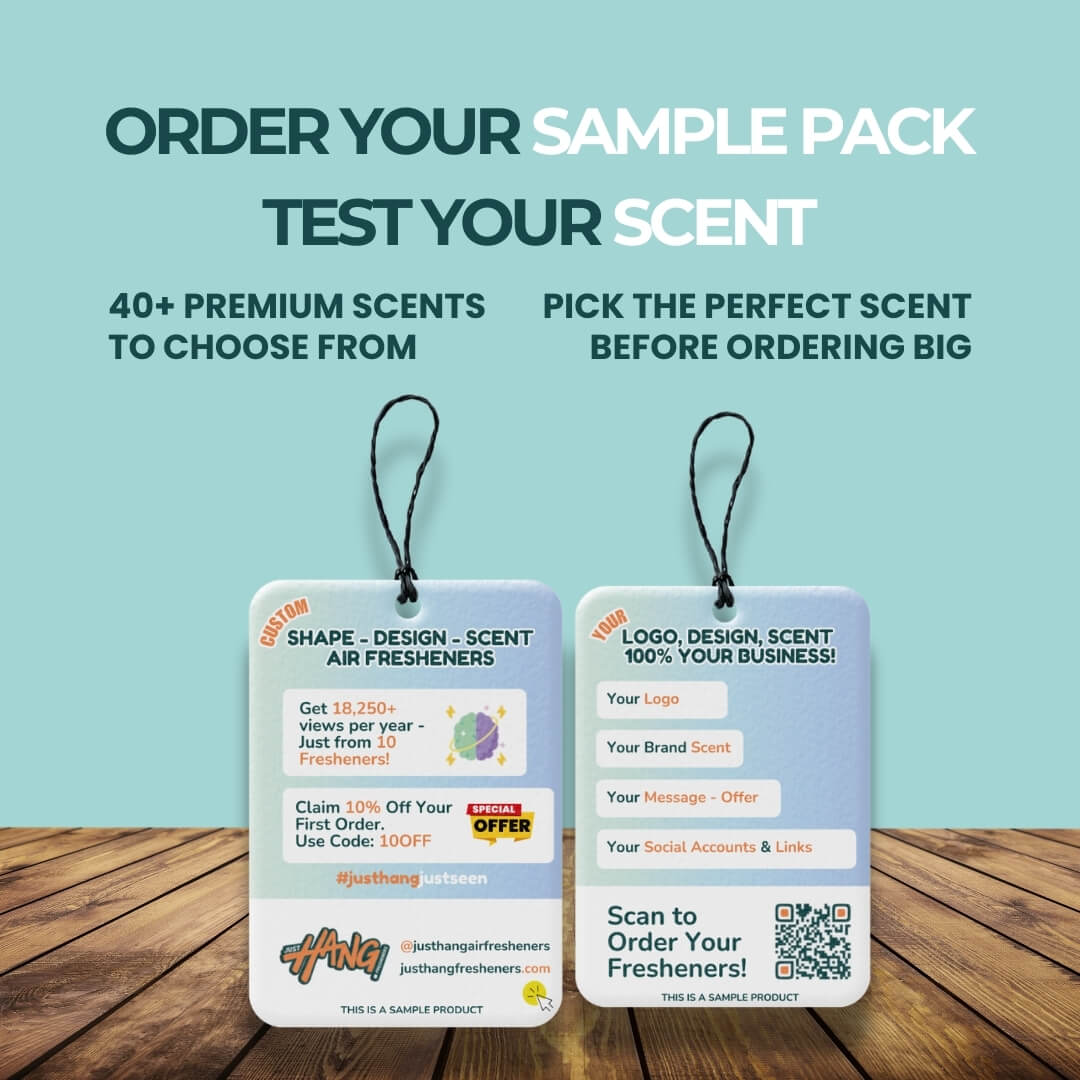
Custom shapes can help recognition, but a complicated outline is not always the best choice. A simple shape that supports your logo may read better from a distance and can be easier to use across future campaigns. Double-sided full-color printing gives you room to put the logo and primary message on one side, with contact details or a return reminder on the other.
Fragrance should also fit the audience. With more than 40 fragrance options, you can choose a familiar, broadly appealing direction rather than selecting something overly specific to a small segment. We do not recommend treating scent as an afterthought. It is part of what makes the item likely to stay in the vehicle, so choose it with the same care you give the printed message.
Professional design help and unlimited revisions remove a common sourcing problem: realizing too late that the phone number is too small or the logo does not reproduce cleanly. Every order should be reviewed and approved before production begins. That approval step is where you confirm spelling, colors, contact information, shape, packaging, and both printed sides.
Build a handoff process your team will actually follow
The most attractive freshener will not improve retention if it stays in a box behind the counter. Give staff a simple instruction tied to a specific customer moment. For example: provide one at completed vehicle pickup, at new-car delivery, with a membership enrollment, or as part of a closing packet.
Keep the handoff natural. “We put one of these in the car so you have our number handy next time” is enough. Employees do not need a long script, and customers do not need a hard sell after paying for service.
If you operate multiple locations, pack and label inventory by branch before distribution. Ask managers to track how many units they receive and when they need more. This helps you avoid one site running out while another has cartons untouched in storage.
Frequently asked questions
What is the minimum order for custom car air fresheners?
The minimum order is 500 units. Larger quantities at 1,000, 2,500, and 5,000 units generally provide better unit pricing for businesses with enough customer volume to distribute them promptly.
How long does the fragrance last?
A hanging paper air freshener can provide fragrance for weeks. Actual duration depends on how it is used, how long it remains in its packaging before use, and vehicle conditions.
Do I need finished artwork before ordering?
No. Free professional design service and unlimited revisions are included. Send your logo and any message, contact details, or rough idea you want included, then approve the final artwork before production.
Can I print different information on each side?
Yes. Double-sided full-color printing lets you use one side for brand recognition and the other for a phone number, service reminder, QR code, or concise offer.
Do you ship nationwide?
Yes. Orders ship free to all 50 states, with customer support, design, and production coordinated from the Atlanta, Georgia area.
If your next customer retention effort needs to stay visible after the service counter interaction ends, request a custom mockup before you commit to a quantity. A clear design, a sensible distribution plan, and an approved proof can turn a small in-car reminder into one more reason customers remember who took care of them.


