



Fresheners Versus Oil Change Coupons Compared
Share
An oil change coupon can get a customer back through the service lane this month. A custom hanging air freshener can keep your shop, dealership, or wash in front of that same driver for weeks. When evaluating fresheners versus oil change coupons, the useful question is not which item is universally better. It is which one solves the gap in your current retention plan.
Coupons are built for action. They give a driver a reason to book now, especially when the offer has a clear expiration date or applies to a service they already expect to need. Fresheners work differently. They create repeated visual and scent-based reminders inside the vehicle, where your customer spends time every day.
For many automotive businesses, the strongest answer is not choosing one over the other. It is using a coupon to create urgency and a branded freshener to make sure the business is remembered after the offer is gone.
Fresheners Versus Oil Change Coupons: Different Jobs
An oil change coupon is a direct-response tool. You can attach it to an invoice, mail it to past customers, or hand it out after a service visit. The customer sees a specific offer, decides whether it is valuable enough, and either redeems it or does not. That makes coupons useful when you need to fill service appointments, promote a slower department, or encourage a return visit before a seasonal deadline.
The tradeoff is short visibility. Once the coupon expires, gets filed in a glove box, or is thrown away, its marketing life is over. A coupon also asks you to give something up, usually margin, to earn the visit. That may be the right choice when a returning customer is worth more than the discount, but it should be a deliberate decision.
A custom air freshener is a brand-presence tool. It does not require an immediate purchase decision. Instead, it puts your name, phone number, website, location message, or next-service reminder where the customer will repeatedly see it: inside the car.
That visibility matters for businesses competing on convenience. A driver may not remember where they bought tires six months ago, but they are more likely to recognize the name hanging from their mirror when it is time for an oil change, detail, repair, or vehicle trade-in conversation.
When an Oil Change Coupon Makes More Sense
Choose a coupon-first campaign when you have a specific service need and can track redemption cleanly. For example, a multi-location quick-lube business may want to increase visits during a slower period. A dealership service department may need to bring back customers whose complimentary maintenance period has ended. In those cases, the offer should be simple enough to understand in a few seconds.
A coupon is also useful when your point-of-sale system can identify the source of the visit. Use a unique offer code, a clear expiration window, or a specific service package. Without that tracking, you may know that visits increased, but not whether the coupon caused the increase.
Be realistic about the offer. A large discount may bring in price-sensitive customers who do not return at full price. A smaller offer tied to a higher-value service can protect margin better, but it may produce fewer redemptions. The right balance depends on your local market, service capacity, and average customer value.
When a Branded Freshener Has the Better Return
A freshener is often the better fit when your business needs name recognition more than an immediate transaction. Detail shops, car washes, independent repair facilities, tire stores, dealerships, insurance agencies, and real estate teams all benefit from staying visible after the initial interaction.
The item has an obvious place to live. Unlike a pen that disappears into a desk drawer or a flyer that gets tossed at the counter, a hanging air freshener is made for the vehicle. It becomes part of the customer's everyday environment while the fragrance lasts.
At Just Hang Fresheners, orders begin at 500 units, with unit economics improving at 1,000, 2,500, and 5,000 pieces. That volume structure matters. If you see 500 customers a year, ordering more than you can distribute quickly may not be the best use of your budget. If your dealership delivers hundreds of vehicles each month or your car wash has steady traffic, a higher quantity can make more sense because each freshener has a built-in distribution moment.
A Simple Exposure Comparison
Think of 1,000 coupons and 1,000 fresheners as two different kinds of inventory. Each coupon creates one offer opportunity. Each freshener creates one branded item placed in a vehicle, where it can be noticed repeatedly over several weeks.
That does not mean a freshener produces 1,000 sales, and it should not be presented that way. Its value is repeated recall. A coupon's value is attributable action. If your business needs both recall and action, place a concise service message on the reverse side of the freshener, then use coupons selectively for targeted follow-up.
How to Combine a Freshener With Service Marketing
The most practical use is often to give the freshener at the moment you have earned the customer's attention: after a completed oil change, detail, repair, vehicle delivery, or wash. The front can carry your logo and a clean visual. The back can include a short reminder such as “See you at your next service” along with your phone number or location message.
Do not turn the freshener into a crowded coupon sheet. Small type, multiple offers, and a long list of services are hard to read in a moving vehicle. If you need a discount code, use one clear offer and make it secondary to the brand. Your goal is for the item to look good enough that people actually hang it.
For dealerships, consider matching the freshener to the delivery experience rather than using a generic automotive design. For a detailing company, before-and-after imagery or a simple premium color palette may fit better. For an oil change chain, a direct service reminder and recognizable location branding usually do more work than elaborate artwork.
Specifications That Affect Whether Customers Use It
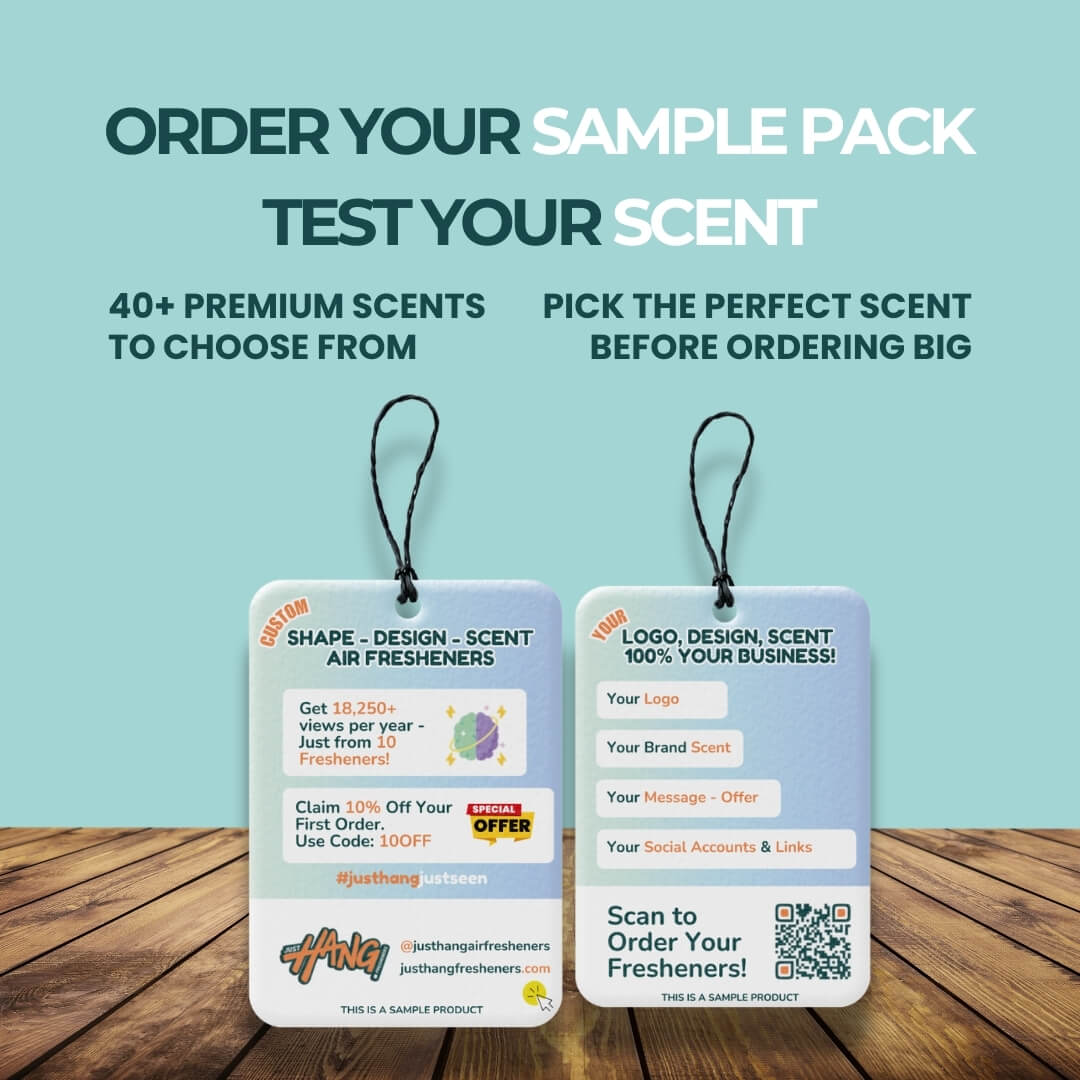
The design and fragrance choice determine whether your freshener feels like a useful finishing touch or a giveaway customers leave behind. You can choose any custom shape, custom sizing, double-sided full-color printing, and from more than 40 fragrance options. Optional branded packaging can be worthwhile for vehicle deliveries, trade show kits, closing gifts, and other situations where presentation matters.
| Decision | Practical guidance |
| --- | --- |
| Shape | Use a shape that supports your logo or message. A simple shape is often easier to recognize from a distance. |
| Size | Choose a size large enough for readable contact information without blocking the driver's view. |
| Artwork | Vector files are preferred when available. High-resolution PDF, PNG, or JPG files can also provide a workable starting point. |
| Fragrance | Pick a broadly appealing option that suits your brand rather than trying to make a complicated scent statement. |
| Packaging | Add branded packaging when the freshener is part of a gift, kit, or higher-touch customer experience. |
We provide professional design service with unlimited revisions, and production does not begin until you approve the artwork. That approval step is where we catch common issues: a phone number that is too small, a logo with insufficient contrast, a message that is trying to do too much, or artwork that will not reproduce cleanly at the chosen size.
Plan the Order Around Distribution, Not Just Price
Before ordering, estimate how many fresheners your team can place in customers' vehicles over the next few months. A single-location repair shop may distribute them with every completed service ticket. A dealership may reserve them for delivery bags and service-lane visits. A franchise can split a larger order by location, provided the artwork and fragrance strategy remain consistent.
Higher quantities generally lower the per-unit cost, but a larger run is only a better buy if it matches your distribution volume and brand shelf life. If your logo, address, or service offer is about to change, a smaller order may be smarter. If your design will remain current across multiple locations, ordering at a higher quantity can reduce the cost of each branded impression.
After artwork approval, the order moves into production and then ships free to all 50 states. Our design, production, and support teams are based in the Atlanta, Georgia area, so you work with a US-based team rather than trying to manage an overseas factory and an unclear proofing process.
FAQ
What is the minimum order for custom car air fresheners?
The minimum order is 500 units. This is designed for businesses, organizations, and promotional distributors rather than individual retail purchases.
How long does the fragrance last?
A hanging paper air freshener is designed to provide fragrance for weeks. Duration varies based on the fragrance selected, how long it remains in its packaging before use, temperature, and vehicle conditions.
Can I put an oil change offer on the freshener?
Yes, but keep the message short. A service reminder, offer code, or next-visit message can work well on the reverse side, while the main side should remain easy to recognize at a glance.
Do I need finished artwork before ordering?
No. You can send a logo and any ideas you have. We include professional design help, unlimited revisions, and customer approval before production begins.
Is shipping included?
Shipping is free nationwide across the United States.
If your current coupon program gets visits but does little for long-term recall, request a custom mockup that pairs your service message with a freshener customers will want to keep in the car.


