



12 Auto Detailing Marketing Ideas That Stick
Share
A freshly detailed vehicle is the moment your customer is most likely to notice your work, take photos, and decide whether they will come back. The best auto detailing marketing ideas use that moment to create a reason for the next visit, not just a one-time compliment.
Detailers often spend money trying to reach broad local audiences while overlooking the vehicles already leaving their bays. Those customers have seen the result firsthand. Your job is to make your name, booking method, and referral offer easy to remember once the shine wears off.
1. Build a follow-up offer into every completed detail
A detail should not end at payment. Give each customer a clear reason to book their maintenance wash, interior refresh, paint correction consultation, or seasonal package before they leave.
The offer does not need to be a deep discount. A simple preferred-customer rate, priority scheduling, or a complimentary add-on with a return visit can work better because it protects your margins. Put an expiration window on it, but choose one that matches your service cycle. A customer who only drives on weekends may not need the same cadence as a rideshare driver or family with two kids and a dog.
Use the same wording at checkout, in your text or email follow-up, and on the physical reminder they take home. Repetition is more useful than a clever slogan nobody recognizes later.
2. Turn branded air fresheners into service reminders
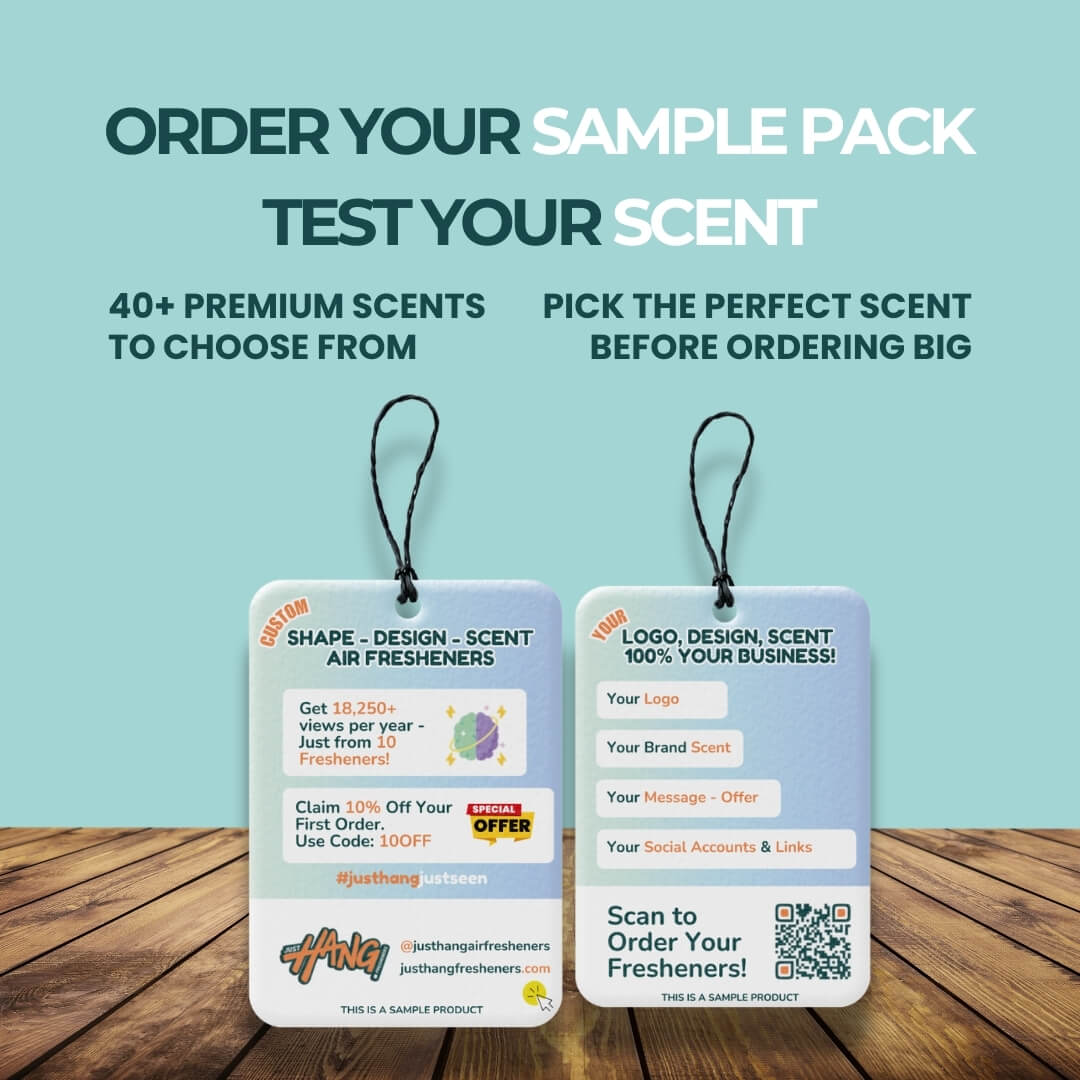
A hanging paper air freshener works well for detailing because it stays where the customer sees it: inside the vehicle you just cleaned. Instead of treating it as a generic giveaway, design it as a small service reminder.
One side can carry your logo and a clean image or short tagline. The other can include your phone number, website, QR code, social handle, or a message such as “Ready for your next detail?” Keep the text large enough to read at arm’s length. A freshener is not a brochure, and cramming in every service you offer usually weakens the design.
The scent lasts for weeks, which gives your shop repeated visibility long after a paper coupon may have been lost. For an order of 500 pieces, even a conservative estimate of one customer seeing the freshener twice a day over several weeks produces far more impressions than a one-time handout. The precise number will vary by driver, but the point is straightforward: the item remains in the place where your customer spends time.
At Just Hang Fresheners, custom orders begin at 500 units and become more economical at 1,000, 2,500, and 5,000 pieces. That pricing structure matters for a busy shop. If you complete 100 vehicles per month, 500 fresheners can support a five-month retention campaign. If you have multiple locations, a larger run may let every location use the same approved brand artwork.
3. Ask for reviews at the right point in the handoff
“Please leave us a review” is easy to ignore. A specific, well-timed request is more effective. Ask after the customer has inspected the vehicle, reacted to the result, and received the keys.
Train your team to say something natural: “If you were happy with the finish, a review mentioning the service you had done helps other local drivers find us.” Then send a short follow-up message the same day while the experience is still fresh.
Do not tie a positive review to a reward or pressure customers at the counter. Your goal is an honest review process that is easy to complete. A QR code on a counter sign can help, but sending the direct review request by text usually creates less friction than asking someone to search while standing in the parking lot.
4. Create referral cards people will actually keep
Referral programs fail when the offer is confusing or the card looks disposable. Give the referring customer one simple benefit and give the new customer one simple reason to book. Avoid stacking exclusions, service tiers, and fine print that your front desk must explain from memory.
A good referral card answers three questions immediately: who it is for, what they receive, and how they redeem it. Pair it with the air freshener in a small branded package if you want the referral message to travel in the vehicle rather than disappear into a wallet.
Track referrals with a short code, a customer name field, or a dedicated booking note. You do not need elaborate software to learn whether your program works. You do need one consistent way to record it.
5. Sell maintenance plans, not only big-ticket details
Paint correction and ceramic coating consultations can be valuable, but a stable detailing business also needs repeatable services between major jobs. Create a maintenance path for customers who have already invested in a full detail.
Explain what the next visit is meant to preserve. For example, an interior maintenance appointment may keep spills and buildup from becoming another full restoration job. The right plan depends on your market, average ticket, staffing, and how far customers travel to see you. A mobile detailer may need a different model than a fixed-location shop with high daily volume.
Make the next service feel like the logical continuation of the one they just bought. That conversation is much easier while the vehicle is clean than three months later when they have forgotten what was included.
6. Partner with businesses that see your ideal drivers
The best local partnerships are not always automotive. Insurance agencies, real estate teams, apartment communities, body shops, tire stores, and independent repair facilities all meet vehicle owners at useful moments.
Give partners a defined offer and materials that make your brand recognizable. For a real estate agent, a branded air freshener included with a closing gift can keep the agent’s name in a client’s vehicle for weeks. For a repair shop, it can be a referral handoff after mechanical work that leaves the interior or exterior needing attention.
Choose partners whose customers match your average job value. A partnership that produces regular maintenance clients may be more profitable than one that sends a lot of bargain shoppers looking for the lowest advertised price.
7. Photograph results for the service, not just the feed
Before-and-after content is useful only if viewers can understand what changed and how to book. Photograph the same angles when possible: driver seat, cup holders, door panels, wheels, paint defects, or pet-hair removal. Consistency makes the work credible.
Use each completed job in more than one place. A strong photo can support a service page, a social post, an estimate follow-up, a counter display, and a seasonal campaign. Get permission before using a recognizable vehicle, plate, or customer information in marketing.
Short videos can work especially well for interior transformations, but do not chase daily posting if your team cannot maintain quality. Two clear, location-specific pieces of content per week can outperform a rushed stream of generic clips.
8. Run seasonal campaigns around real vehicle problems
Seasonal marketing works when it connects to what drivers are dealing with. Winter road grime, spring pollen, summer travel, back-to-school messes, and holiday road trips all create natural reasons to promote a specific service.
Build the campaign around a service outcome rather than a calendar holiday alone. “Get the family vehicle ready for summer travel” is more useful than a vague summer sale. Use the same campaign on booking messages, counter signage, social posts, and take-home fresheners so the offer is recognizable.
9. Make your fleet and business accounts easy to buy
Small business fleets, real estate teams, sales organizations, and field-service companies can provide recurring work, but they want predictable scheduling and a simple approval process. Prepare a one-page service menu with the vehicle types you accept, what is included, and how account billing or scheduling works.
Do not promise every vehicle can be completed in the same window. Vans, work trucks, and heavily used vehicles require different labor assumptions. Clear expectations protect both your schedule and the client relationship.
A branded air freshener can also support fleet accounts when the client wants a finished vehicle to feel customer-ready. Use the client’s brand only with approval, and keep your own referral information discreet if the arrangement calls for it.
10. Improve your estimate follow-up
Many detailing leads do not say no. They get busy, compare options, or hesitate because the service feels like a discretionary expense. A structured follow-up can recover work without sounding pushy.
Send a short message after the estimate that restates the service, answers the most likely concern, and makes the next action easy. For correction work, show the condition you observed and explain the expected improvement honestly. Avoid guaranteeing perfection when paint condition, prior repairs, or deep defects make that unrealistic.
Follow up again only when you have something useful to add, such as an opening in the schedule or a relevant seasonal service. Repeated “checking in” messages with no new value can damage trust.
11. Standardize the customer handoff
A consistent handoff is a marketing system. It ensures every customer hears how to maintain the result, when to return, how to refer someone, and where to leave feedback.
Give your team a short checklist:
- Walk the customer around the finished vehicle.
- Explain the service completed and any limitations found.
- Present the next recommended service.
- Ask for a review if the customer is pleased.
- Provide the branded take-home item and referral offer.
12. Measure the marketing ideas that lead to booked work
Track where each new inquiry came from, what service they booked, whether they returned, and whether they referred someone. A basic spreadsheet is enough to start. The goal is not perfect attribution. The goal is to stop spending blindly.
Review results monthly. If a partnership produces many inquiries but few qualified bookings, adjust the offer or move on. If a freshener-based referral code brings in repeat customers, order quantities may justify moving from 500 units to a higher volume tier. Marketing becomes easier to fund when you can see which activities create actual appointments.
Auto Detailing Marketing Ideas: Getting the Freshener Right
Artwork and fragrance choices affect whether customers use the item. For most detailing shops, a simple custom shape, high-contrast logo, phone number, and booking prompt are enough. Double-sided full-color printing gives you room to separate the brand message from the return-visit message.
Start with a vector logo file when available, such as AI, EPS, PDF, or SVG. High-resolution PNG and JPG files can also work when the artwork is clear. If all you have is an older logo or a rough concept, free professional design help and unlimited revisions can close that gap. You should still review every spelling, phone number, QR code, and logo treatment before approving production. Approval is the point where preventable mistakes should be caught.
Choose fragrance based on your customers and brand personality, not on what your staff happens to like best. Clean, citrus, fresh, and warm fragrance families each create a different impression. If you operate a premium coating studio, a cleaner and more restrained choice may fit better than a novelty scent. With more than 40 fragrance options available, ask for guidance if you are narrowing down a large campaign.
For a custom mockup that fits your detailing business, request a quote with your quantity, preferred shape, artwork, and intended use. Free shipping is available nationwide, and US-based design and support teams can help you get the approval details right before production.
Frequently asked questions
What is the minimum order for custom detailing air fresheners?
Custom orders start at 500 units. Higher quantities of 1,000, 2,500, and 5,000 generally reduce the per-unit cost and can make sense for multi-location shops or recurring customer giveaways.
How long do hanging paper air fresheners last?
Scent duration varies with fragrance selection, vehicle temperature, and whether the customer opens the protective packaging gradually. In normal use, they are designed to provide brand visibility and fragrance for weeks.
Can a detailing shop use its own design?
Yes. Supply your logo and any required text or artwork. Vector files are preferred, but high-resolution image files may work. Professional design service and unlimited revisions are included, with customer approval required before production.
Are custom air fresheners shipped across the United States?
Yes. Orders ship free to all 50 states. Production, design, and customer support are US-based in the Atlanta, Georgia metro area.
A customer may forget the exact day you detailed their vehicle, but they should not have to forget who did it. Put your next-booking message somewhere their eyes will naturally return to, then measure whether it brings them back.


